
Why Söğüt?
According to the TDV Encyclopaedia of Islam, Ertuğrul’s community received Söğüt as winter quarters and Domaniç as summer pasture on the outer frontier. In the mid-thirteenth century this was an active borderland between the Seljuk world and Byzantine Bithynia.
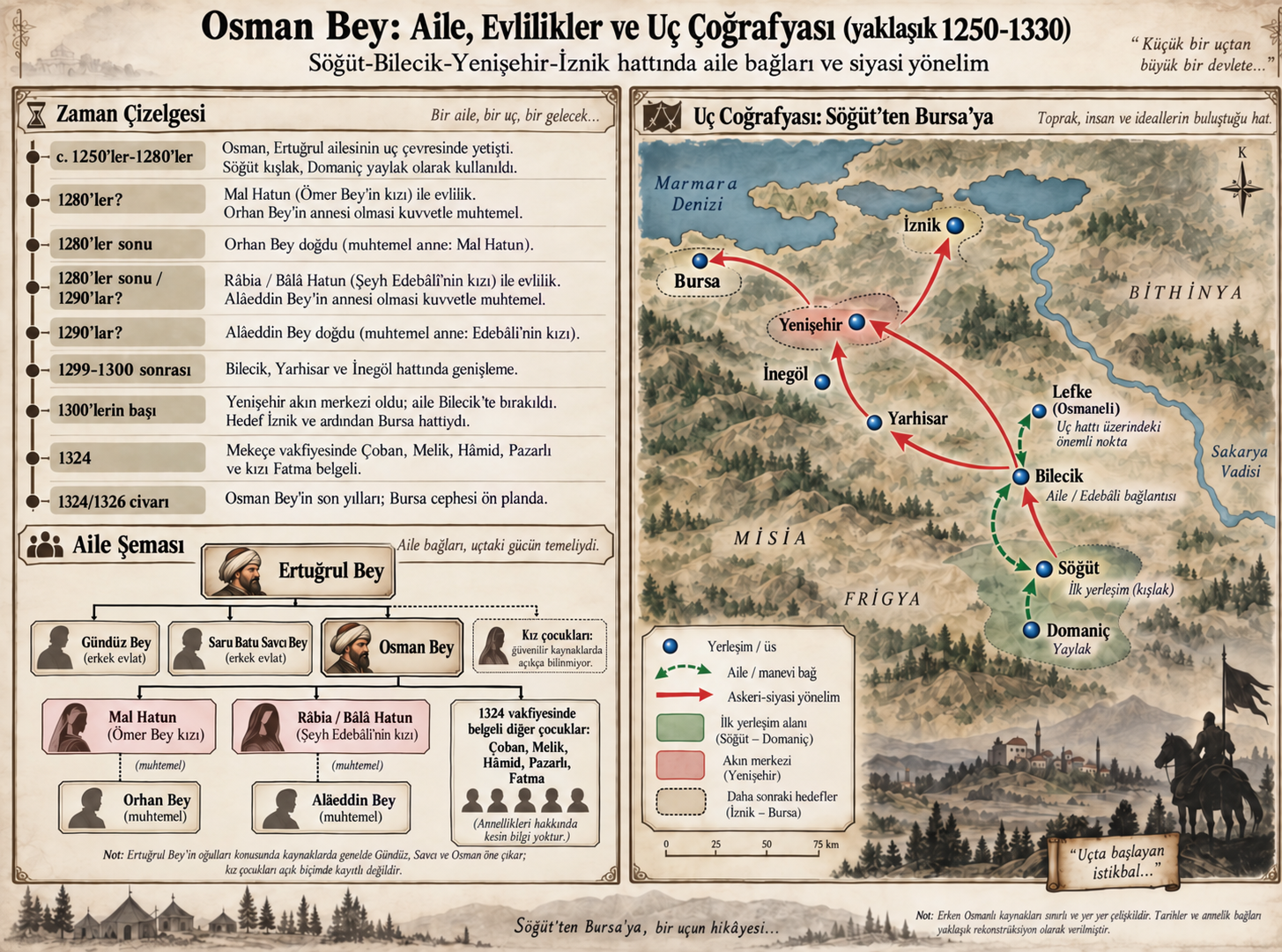
Osman Bey’s location was therefore not arbitrary. The Söğüt–Domaniç base inherited from his father lay on the edge of a frontier opening towards Bilecik, Yarhisar, İnegöl, Yenişehir, Lefke and İznik.
The Ertuğrul entry reports good relations with the Byzantine lords of Bilecik and Lefke/Melangeia. Under Osman, these relations developed into military and political expansion.
Osman Bey and Lefke
The Söğüt–Bilecik Frontier
Osman Bey’s sphere expanded around Bilecik, İnegöl and Yenişehir, where Byzantine lords and Turkmen frontier communities met.
Yenişehir and the Sakarya Corridor
Osman’s campaigns focused on fortresses and settlements around İznik and opening towards the Sakarya valley.
The Submission of Lefke’s Lord
The TDV entry on Osman I states that the lords of Çadırlu and Lefke pledged allegiance, remained in place and became Osman’s retainers (nöker). Osman then advanced towards Mekece and Akhisar.
Family and Frontier Geography
Some source maps, charts and plans retain Turkish labels; the captions are in English. Label key: harita = map; köy = village; merkez = town centre; yol = road; nehir = river; nüfus = population; göç = migration; yıl = year; kadın = female; erkek = male; eski = historical; güncel = present-day; compass K/D/G/B = N/E/S/W.
The 1304 Sakarya Campaign: A New Field Assessment
Arıkan and Çetin’s 2025 study interprets Osman Bey’s activities along the Sakarya as efforts to control routes towards İznik. It considers Leblebici, Çadırlı and Lefke castles alongside Mekece, Akhisar and Geyve, comparing chronicles with field observations. Its date of 1304 should be read with attribution alongside the other sources’ date ranges above. Arıkan and Çetin, 2025, pp. 109–124.
Fortresses, Passes and River Mouths
The authors argue that small fortifications and watchtowers, as well as major city walls, matter for understanding the early Ottoman landscape. They favour remains around Bayırköy for Çadırlı and discuss different locations for Lefke. pp. 120–125.
Samsa Çavuş and Göksu
Linking the small stronghold granted to Samsa Çavuş in the chronicles with the Göksu towers rests on comparison of texts and geography. This interpretation is not a definitive archaeological identification or a new historical boundary. pp. 123–124.
Contribute to the Research
If you have photographs, documents, gravestone records or family accounts relating to Lefke, please share them with us.
✉ Contact Form